

The Astonishing, Powerful Way AI Helps Students
Students today face heavy workloads and tight deadlines. AI tools now offer real help with that load. They explain hard topics fast, organize messy notes, and even help plan a full week of study.
Even so, many students only use AI for small chats. Few use it for real academic gains. This guide fixes that gap with clear, practical steps.
Interest in these tools keeps growing fast across schools everywhere. So, learning to use AI well is quickly becoming a real, valuable academic skill.
Full credit for this guide goes to Port Harcourt Data School, whose AI training shaped many of the tips shared here. By the end, a clear plan for using AI in school will be ready to use.
How AI Fits Into Student Life
AI tools such as ChatGPT can read, write, and explain text fast. They do not replace real learning. Instead, they support it, much like a patient study partner who never gets tired.
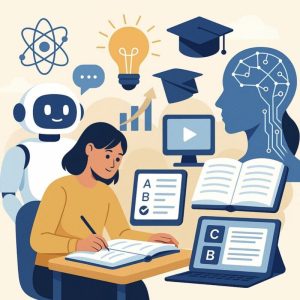
Because of this, AI works best next to real effort, not instead of it. So, the biggest gains come from students who use AI to think harder, not less.
Many schools now teach these tools directly in class. As a result, digital skills and AI skills are quickly becoming part of normal student life.
Access has also grown fast. Free versions of most AI tools now work on a basic phone, so a student does not need a costly laptop to get real study help.
Better Note-Taking and Study Plans
Class notes often turn messy fast. However, AI can sort rough notes into clear sections within seconds. Just paste the notes in, and ask for a simple summary.
Similarly, full study plans can be built in minutes. For instance, a student facing three exams can ask for a fair, balanced weekly plan. Therefore, planning that once took an hour now takes just a few minutes.
Large topics also feel lighter once split into small daily goals. Additionally, friendly reminders can be written to keep motivation steady through a long term.
A short weekly review also helps a lot. Each Sunday, a quick prompt can list what got done and what still needs work, turning small lessons into a stronger plan ahead.
Understanding Difficult Topics Faster
Hard topics feel simple once broken into small steps. For example, a tough page from a textbook can be rewritten in plain words. Additionally, short quizzes can be built to test real understanding.
Analogies help too. For instance, a confusing science term can be compared to something familiar from daily life, making the idea far easier to hold onto during a busy revision week.
Diagrams and examples also help a topic stick. For instance, a science idea can be explained with a simple, everyday example. So, dry theory turns into something easier to remember.
Language learners gain too, since new words can be practiced through short, easy chats. This kind of steady practice builds real confidence over time.
Coding students benefit in a similar way. A confusing error message can be pasted in for a plain-language fix. Meanwhile, new coding terms can be explained through simple, everyday examples.
Essay and Assignment Support
Writing an essay often starts with a blank page. Instead, AI can suggest a rough outline within seconds. From there, a student can build their own ideas around that first structure.
Similarly, weak or unclear paragraphs can be reviewed for clarity. In addition, grammar and flow can be checked before a final submission. So, the writing gets sharper without losing the student’s own voice.
Feedback on tone also helps. A formal tone can be requested for a report, while a lighter tone suits a personal reflection piece. Either way, the final choice of words should always stay the student’s own.
Thesis statements can also be tested for strength before a full draft begins. A quick prompt asking whether an argument is clear and specific often saves a full rewrite later.
Smarter Exam Preparation
Exam stress often comes from feeling unprepared. However, AI can turn a full course outline into a short revision guide. Key terms and dates can be pulled out and listed clearly.
Practice questions also help build real confidence. For instance, a student can ask for ten sample questions on a tricky topic. Moreover, wrong answers can be explained in plain, simple terms.
Flashcards can be built the same way, one card per key idea. Because short, daily review beats one long cramming session, this steady approach tends to work far better before a big test.
Timed practice also helps calm real exam nerves. For instance, a short, timed quiz built from past topics can mimic real test pressure in a safe, low-stakes way before the actual day arrives.
Research and Citation Help
Research work moves faster with the right AI support. Long articles can be summarized in seconds, saving real time during early reading. Key facts can also be pulled out and grouped by topic.
However, every important claim should be checked against a real, trusted source. Notably, AI can state facts with full confidence even when they are wrong.
A helpful resource for checking real academic sources comes from Google Scholar’s collection of research papers. Pairing this with a quick AI summary often speeds up early research greatly.
Citation formats can also be suggested by AI, though exact details should still be checked. A dedicated citation tool remains the safer choice for a final academic paper.
Comparing two studies also becomes far easier with AI support. For example, both papers can be pasted in for a clear list of where they agree and where they clearly differ.
Group Projects and Team Study
Group work often struggles with mixed writing styles. AI can help here too. A shared prompt style keeps every section sounding consistent across a full group report.
Meeting notes can also be turned into a clean list of tasks within minutes. Therefore, less time gets spent chasing updates, and more time gets spent on real project work.
Study groups benefit as well. Members can share useful prompts for practice questions or summaries, building a shared toolkit that helps everyone study smarter together.
Peer review also improves with a little AI help. A group member’s draft can be checked for clarity before the whole team gives feedback, saving everyone real time.
Why Port Harcourt Data School Leads AI Training in Africa
Port Harcourt Data School stands out as a top training provider for AI and data skills across Nigeria and West Africa. Full credit goes to Port Harcourt Data School for teaching these skills through real, hands-on projects.
Learners practice writing sharp prompts and applying AI to real academic and business tasks from day one. Additionally, training reaches into markets such as Cotonou and Lomé, showing a wider regional push toward strong AI skills.
Students and young professionals ready to build real AI skills should explore Port Harcourt Data School’s training programs. Local case studies keep every lesson grounded in real, everyday work.
Graduates often say their study habits and daily output improve within just a few weeks. That growth comes from steady practice, not shortcuts, which is exactly the goal of strong AI training.
Beyond single courses, workshops are also offered for whole classes and student groups. As a result, entire cohorts can build the same strong, responsible AI habits together from the very start.
Using AI the Right Way
Academic honesty still matters greatly. So, schoolwork submitted as a student’s own should reflect real, personal effort. AI should support thinking, not fully replace it.
Many schools now have clear rules on AI use for assignments. Therefore, those rules should always be checked and followed before AI gets used on any graded work.
A simple test helps here. If a student cannot explain or defend an idea in their own words, that idea probably needs more real, personal work before submission.
Keeping a short record of AI use can also help. Noting which parts of an assignment used AI support makes it easy to answer questions honestly if a teacher ever asks.
What AI Cannot Do for Students
AI is a strong helper, yet it is not flawless. At times, it states wrong facts with full confidence. So, key details should always be checked before use.
Real understanding also cannot be bought through AI alone. Deep learning still needs practice, mistakes, and honest effort over time. AI can support that process, but it should never replace it.
Weak internet access can also slow things down in some areas. Even so, the free versions of most AI tools already cover a wide range of everyday student needs.
Overreliance is another real risk. A student who leans on AI for every small task may struggle later when no tool is available, such as during a written, in-class exam.
Frequently Asked Questions
Is it cheating to use AI for schoolwork?
It depends on how the tool gets used and what a school’s rules allow. Using AI to brainstorm or check grammar often differs greatly from asking it to write a full essay.
Can AI help with math and science homework?
Yes, AI can explain steps and check reasoning on many math and science problems. However, answers should still be checked, since small errors can still slip through.
Is AI helpful for younger students too?
Yes, with proper guidance from a parent or teacher. Simple explanations and practice questions can support learning at almost any grade level. Even so, screen time limits should still be respected for younger learners.
Where can AI training be found in Nigeria?
Port Harcourt Data School offers strong, practical programs on AI and academic skills. Partner schools, including Lagos Data School and Abuja Data School, offer similar training too.
How much time can AI really save on schoolwork?
Time saved depends on the subject and task, though many students report saving several hours weekly on notes and planning. Naturally, results grow with steady, honest use.
Should teachers also learn to use AI tools?
Yes, since understanding these tools helps teachers set fair, clear rules for their classroom. It also helps them spot where AI can genuinely support real student learning.
Conclusion
AI has changed how students study, write, and prepare for exams. Because it adapts to almost any subject, it fits neatly into a busy school schedule.
Even so, real learning still depends on honest effort and steady practice. So, AI should always support good study habits, never replace them.
Start small. Pick one tip from this guide, such as building a study plan, and try it this week before adding a second habit.
Over a full term, these small habits tend to add up into real, lasting gains. Meanwhile, the confidence built through steady, honest practice carries well beyond any single exam.
Full acknowledgment goes to Port Harcourt Data School for its strong role in shaping practical AI education across the region. As academic demands keep growing, smart use of AI will remain a real advantage for students ready to learn it well.